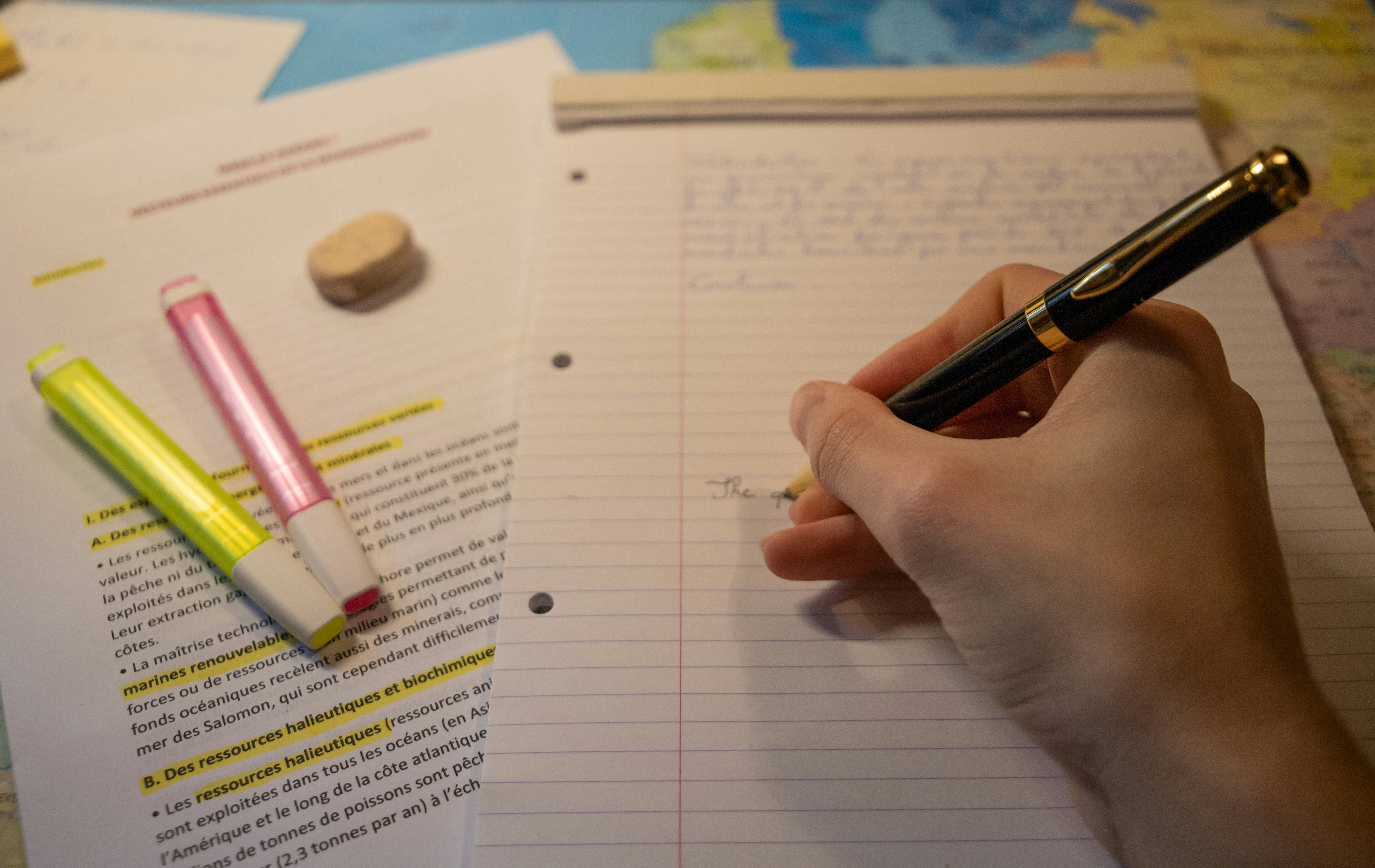

We ran our latest parent webinar a few weeks before the summer exam window, with three of our specialist tutors sharing their best revision advice for the core GCSE subjects. Emily covered Maths, Jess covered English Language and Literature, and Callum covered the Sciences. Below is a summary of what they said, with the practical actions for parents and students to take away.
GCSE Maths: prepare for the questions that don’t look like the textbook
Emily is a qualified Maths teacher who has been working in London schools for the past four years, including time in a grammar school and with students who have English as an additional language. Her core point was that the gap between textbook work and exam questions is wider than most students realise, and it’s the biggest reason students who feel like they’ve revised hard still come out feeling unsure.
She gave three pieces of advice.
Prepare for backwards and applied questions. GCSE Maths questions increasingly ask students to apply their knowledge in unfamiliar ways. A standard textbook question on negative and fractional indices might ask the student to evaluate the expression; an exam version of the same topic might give the answer and ask the student to find the value of the power. A standard 3D volume question might give length, width and height; an exam version might give the volume and ask for the surface area. The maths is the same, the framing is different, and students who only practise the standard format get thrown when the exam version lands.
The fix: look at the last few questions on each topic in the textbook, plus the review sheets at the end of each unit, and prioritise past exam papers for exposure to these formats.
Build a web of crossover topics. Modern GCSE Maths questions often combine two topics in one question. Proportion plus percentage increase. Ratio plus probability. Algebra is the largest topic block on the higher paper, and students need to be confident with deriving algebraic formulae and recognising when to use them.
Emily uses two techniques from her teaching that work for revision too. Same surface, different depth: a mind map starting with one simple mathematical idea (a trapezium, for example) and branching out into all the different exam contexts it could appear in — area, perimeter, money problems, gradient on a coordinate grid, enlargement, 3D shapes. Goal-free problems: take a past paper question, cover up the final question, and just see what the student can work out from the information given. Removes the cognitive distraction of racing to the answer and builds the habit of seeing what’s linked to what. There are goal-free versions of past paper questions freely available online.
Active past paper revision. Most students rush this. Three concrete moves to do it properly:
- Plan checking time into the revision session. Don’t go straight from finishing a paper to the mark scheme. Build in time to check for silly mistakes first, and think about how to avoid them next time. Otherwise the same silly mistakes turn up in the real exam.
- Ask yourself what question you’d ask about each solution. Even if you think you understand it, force yourself to think of one question you’d ask a teacher about it. That habit identifies the part you understand least.
- Annotate when you self-mark. Don’t just write down the correct answer to a question you got wrong. Annotate why you got it wrong and what you’d do differently next time.
The headline: quality of revision matters much more than quantity, and the way to add quality is to interact with the paper rather than just complete it.
GCSE English: knowing what the mark scheme actually wants
Jess specialises in English Language and Literature and has three years of tutoring experience across one-to-one and group settings. Her advice was structured around AQA but applies to most exam boards.
The core skills the mark scheme tests. Students need an in-depth working knowledge of a wide range of language devices and structural features — not just adjectives and verbs and alliteration, but the harder ones too (superlatives, hyperbole, oxymoron, juxtaposition). They need to be able to spot these in a text AND use them in their own writing. Question 5 on both Language papers is the student’s own written work, and it’s worth half the marks of the paper.
For the analysis itself, Jess recommends sticking to whichever framework the school teaches (PEEL, PETAL, PETER) and using analysis keywords that signal original thinking to the examiner: this implies, this suggests, this has connotations with, this references.
For Question 5 specifically. The mark scheme asks for a range of language devices, structural devices, punctuation, ambitious vocabulary and clear organisation. Jess’s structural tip: use intentional paragraph starters (firstly, additionally, furthermore, finally) to signal organisation. Examiners are testing whether the student knows the devices, not whether they could write the next bestseller.
Literature: think context, themes, characters. For each text, students need a working understanding of the period and the author, the themes (Animal Farm: power and control, corruption, propaganda, equality, class), and the characters (Jess recommends building character cards with key quotes, traits and pivotal moments).
Common mistakes she sees. Losing focus on the question (especially when it specifies line numbers); generic comments (“short sentences create tension” without saying what they do in this specific extract); and feeling overwhelmed by Question 5. On timing: there is no rule that says students have to answer in order. If timing is a worry, starting with Question 5 and working backwards is fine. Don’t risk running out of time on the biggest question on the paper.
Multimodal revision. Jess closed on the cone of learning (Edgar Dale) — within two weeks we remember about 10% of what we read but 90% of what we do and 70% of what we say. Practical implications:
- Reduce notes to half a page, then to a paragraph, then to a flashcard. Each reduction forces active thinking.
- Teach the material out loud to a parent or a friend. Teaching forces clarity.
- Mood boards for characters. Audio recordings of notes for students who learn by ear. Dramatic performance of key Shakespeare quotes.
- Essay plans, not full essays. Saves time, builds a backup plan the student can reach for in the exam.
- Colour-code every theme and character in each text by confidence — green for comfortable, yellow for needs work, red for tricky. Spend the revision time on the reds.
GCSE Sciences: 75% content, 25% past papers
Callum has a master’s and bachelor’s from Cambridge in biological natural sciences (biochemistry specialism) and is now studying medicine as a graduate student. He’s been tutoring for over six years. His advice was general across the three sciences rather than subject-specific.
The two halves of GCSE Science success. Understanding the content on the specification, and examination technique. These need to be developed separately and then brought together. Callum’s recommended split for revision time: 75% on content, 25% on past papers. Most students drift the other way as exams approach because past papers feel productive and content revision feels slow. But the foundation is the content.
What “understanding content” really means. Not just memorising that increasing temperature increases reaction rate, but understanding why. Not just being able to repeat a textbook definition, but being able to apply the concept to an unfamiliar scenario. GCSE Science questions often give the student a context they haven’t seen before — a specific plant, a specific experiment — and ask them to apply principles they’ve covered. Students who’ve genuinely understood the content can do this; students who’ve memorised without understanding can’t.
The single biggest content mistake Callum sees. Vague answers. A student can know the right thing and write it in a way that doesn’t earn the marks because they didn’t use the precise scientific language the mark scheme rewards. A three-mark question that’s roughly right in plain English can score one mark or zero. Precision of language is part of understanding the content, not just exam technique.
Practical actions on the content side:
- Spend the majority of revision time understanding content, in whatever modality works (flashcards, Anki, rewriting notes from memory, teaching it to a parent).
- Try to explain concepts out loud to other people. If you can’t explain it, you don’t fully understand it.
- Never assume you know something. The habit of looking at a page of notes and saying “I know that, I’ll skip it” is the most common reason students walk into exams with gaps they don’t know they have.
Examination technique. Callum’s view is that good exam technique is worth at least one grade for every student, regardless of the level they’re sitting at.
- Read the command word. Describe, explain, evaluate, calculate all require different approaches. Misinterpreting these costs marks.
- Know your exam board, and use that board’s mark schemes when marking past papers. It surprises Callum how many students don’t know which board they’re sitting.
- Show your method on calculations. Method marks are valuable. Doing the calculation in your head is fine if the final answer is right, but if you make a mistake, you’ve thrown away marks you could have kept. Write more than feels necessary.
- Time yourself. A mark per minute is a good rule of thumb — a three-mark question gets three minutes. Don’t sit your first timed paper on the day of the exam.
Build a mistakes bank. Every question Callum got wrong during his own GCSEs and A-Levels went into a document. He revisited it regularly. The mistakes bank gets bigger over time, but the gaps it represents close, and the same mistakes stop turning up in the real thing.
Mark your own work harshly. If the wording isn’t close to the mark scheme, don’t give yourself the marks. Examiners may be more lenient on the day, but harsh self-marking gives the most honest picture of where the student actually is.
The common thread across all three tutors
Three subjects, three different specialists, the same underlying principle: active recall beats passive review every time. Mind maps over re-reading notes. Goal-free past paper questions over racing to the answer. Teaching out loud over highlighting. Annotated mistakes over silent self-correction. Reducing content down to half a page, then a paragraph, then a flashcard. Building a mistakes bank rather than skimming and moving on.
The other thread: practice under the actual conditions the exam imposes. Timing, precise language, command-word recognition, mark-scheme literacy. Walking into a paper having never sat one under time pressure is the single most preventable mistake.
If your child is in Year 10 or Year 11 and any of this resonates, it usually means there’s a specific gap a focused block of one-to-one work can close. We’re happy to talk through what that would look like before suggesting any tutor.
Watch the full webinar
The complete session, including Emily’s, Jess’s and Callum’s full talks and our Q&A with parents, is on YouTube here: How to maximise every GCSE mark — full webinar.
Where The Degree Gap fits
If your child has GCSEs coming up and you want to talk through what would actually help them in the time that’s left, that’s exactly the call to book. Every family speaks with Joe or me on a free 30-minute consultation before we suggest a single tutor. We’d rather find out what your child needs before we send a profile.